Web Analytics

Impact of VAEformer Compression Algorithm Precision Loss on the Tropospheric Delays

Abstract

Conventional tropospheric delay products typically provide delay parameters (zenith delay + mapping function + horizontal gradients) through parametric modeling at specific geodetic stations (GNSS/VLBI/SLR/DORIS) or low-resolution surface grid points (5°×5°/1°×1°). Slant delays retrieved by users via parametric models inevitably suffer from modeling errors and interpolation errors (horizontal + vertical) when transferring parameters from grid points to target stations.
         This paper presents a novel non-parametric modeling approach for high-precision tropospheric delay retrieval, based on the VAEformer compression algorithm. Under this scheme, ERA5 data with 37 pressure levels at a 0.25°×0.25° resolution for one epoch is compressed into a volume smaller than that of one epoch of VMF3 (1°×1°) products. Users can compute slant delays locally after downloading and decompressing the data, thereby avoiding errors introduced by parametric modeling.
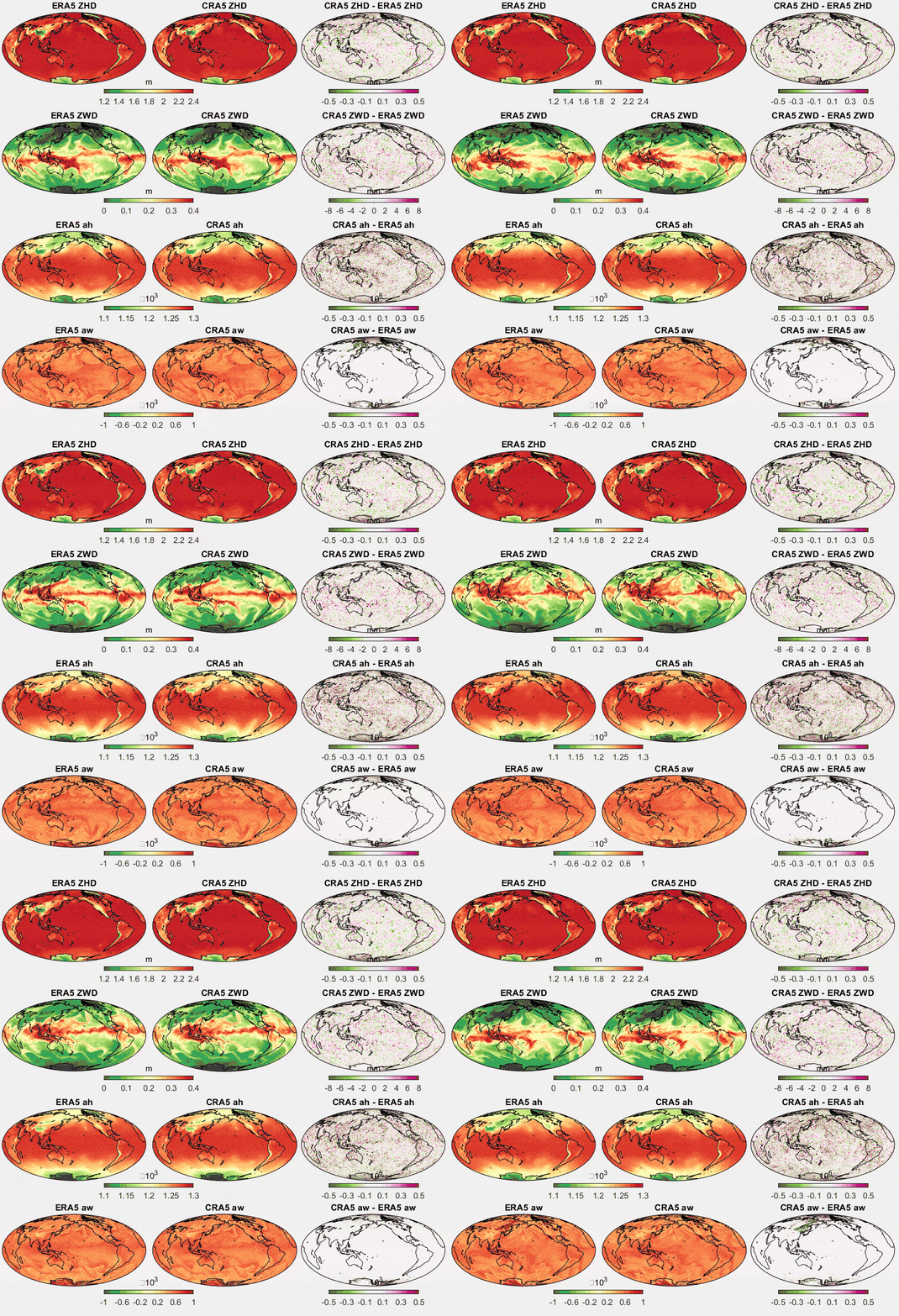
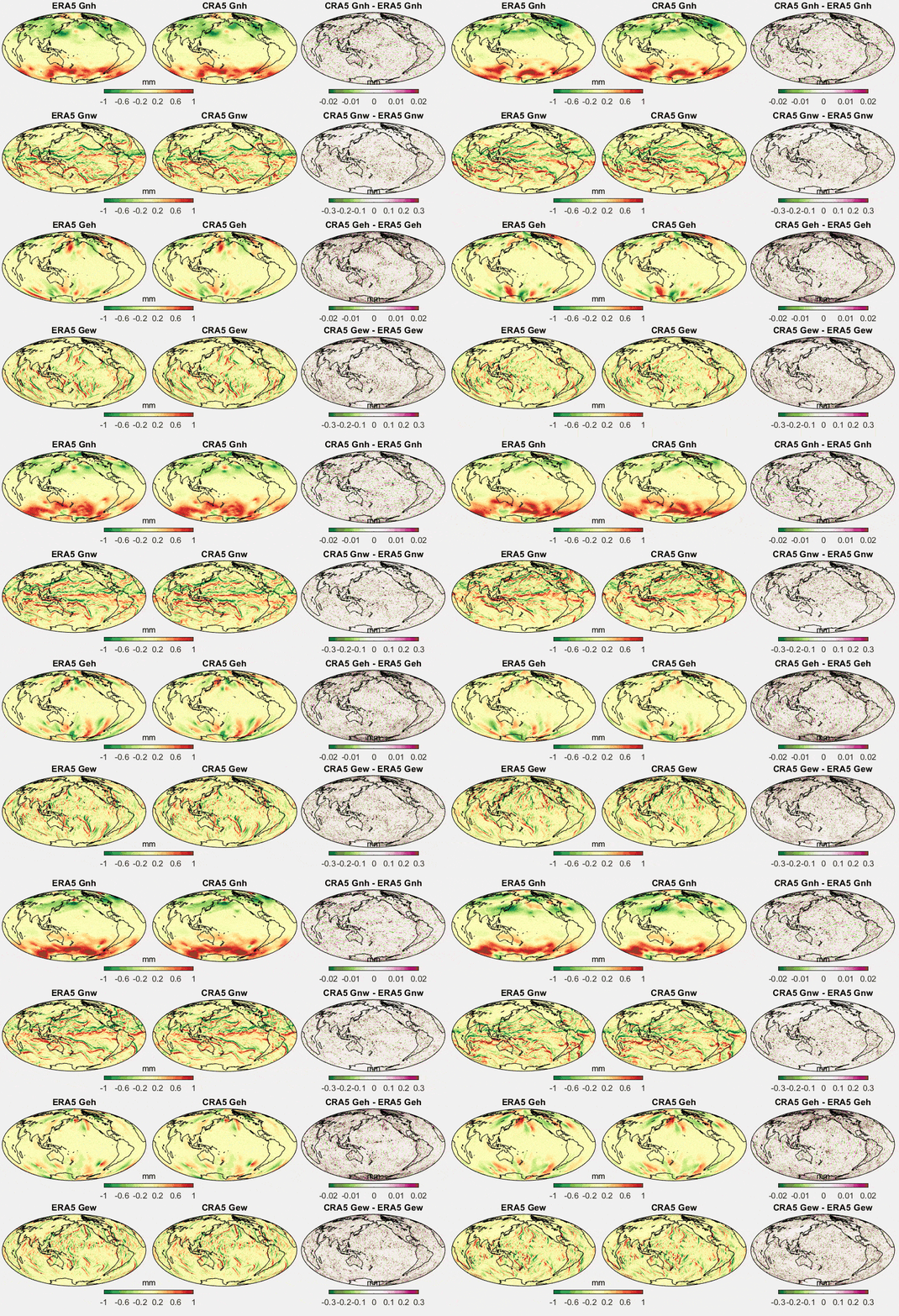
         Evaluation results show that the ZTD accuracy degradation due to this compression is less than 2 mm globally. Using more than 5,000 GNSS stations' ZTD over one year as reference, the difference between the new scheme and results calculated from original ERA5 is less than 0.2 mm. A case assessment of GNSS water vapor retrieval demonstrates that PWV accuracy degradation is reduced from 0.760 mm under the parametric approach (VMF1 grid) to 0.046 mm under the new scheme—an improvement exceeding 93.95%, representing a significant advancement in atmospheric remote sensing and space geodesy.

Differences between ERA5 Trop & CRA5 Trop

BibTeX

@article{ding2025impact, title={Impact of VAEformer Compression Algorithm Precision Loss on the Tropospheric Delays for Microwave Remote Sensing}, author={Ding, Junsheng and Xu, Cancan and Chen, Wu and Chen, Junping and Wang, Jungang and Zhang, Yize and Bai, Lei and Han, Tan and Xiong, Yuhao}, journal={IEEE Transactions on Geoscience and Remote Sensing}, year={2025}, publisher={IEEE} }

Total Visits: